In Charlie LeDuff's book Detroit an American Autopsy, there are a number of fallacies used from The Thinker's Guide to Fallacies: The Art of Mental Trickery and Manipulation. Some of the Fallacies used are:
#5 Appeal to Fear
This fallacies is used in many parts of the book. It is shows on how corrupt the government is in Detroit. The government has many people controlling the face figure of who the citizens see to go through with their own ideas. These figures are being controlled through fear of what could happen to them if they don't listen.
#14 Devise Analogies
This fallacies is used metaphors and analogies to get your point out to the audience and could be false. In the book, LeDuff uses this fallacies to show how bad a situation is in the book. How little things could mean a lot in Detroit, and how the situation is very shocking.
#19 Demonize His Side, Sanitize Yours
This fallacies is basically putting your view as good and other's view as bad. This is used in LeDuff's writing because all LeDuff is writing about is the bad Detroit and he doesn't include the parts of Detroit that are decent to see. He only talks about the parts in Detroit that are run down and need help from the government. But there are nicer areas in Detroit isn't what LeDuff describes in his book.
Monday, May 19, 2014

Fallacies found in Detroit: An American Autopsy
Reading the Fallacies book helped me connect many of the mental manipulations to the book Detroit: An American Autopsy, since a lot of the book focuses on the corrupt politics of Detroit as a city. However, the fallacy that stood out to me as I was reading Detroit, was "Dirty Trick #7: Appealing to popular passions". This trick was unique, because it was not the author, Charlie LeDuff using a fallacy to manipulate the reader, but the new mayor using it to appeal to the voter. "After retiring from basketball, he started his own business manufacturing auto parts in Detroit. He ran his mayoral campaign tutoring this executive acumen" (p.176).
Although his statement appealed to the voters of Detroit, LeDuff adds: "An elegant, introverted and geriatric figure, Bing neglected to tell the voters that his business was failing and that it had existed hand-to-mouth for a number of years" (p.176). This shows that Bing was appealing to the voters of Detroit by identifying with being apart of the auto industry and starting his own company (to show success) but denied telling the voter the whole truth.
Although his statement appealed to the voters of Detroit, LeDuff adds: "An elegant, introverted and geriatric figure, Bing neglected to tell the voters that his business was failing and that it had existed hand-to-mouth for a number of years" (p.176). This shows that Bing was appealing to the voters of Detroit by identifying with being apart of the auto industry and starting his own company (to show success) but denied telling the voter the whole truth.
Fallacies in Detroit
Appeal to Pity is used by Mario Willis when trying to escape prison time for hiring an arsonist who ended up killing Walt Harris: "I just once again, just thank you. I ask you to have mercy upon me and I'm very humbled by the situation."
LeDuff's coverage of Monica Conyers is a subtle and ongoing invocation of Make Your Opponent Look Ridiculous. Conyers is consistently portrayed as a caricature of a spoiled, vain, hot-tempered weasel.
LeDuff also employs Demonize Their Side, Sanitize Yours throughout the book. He portrays himself as a bold, fearless hero crusading to expose Detroit's evils, while his opponents are crooks and cheaters who are destroying the city.
Fallacies in Charlie LeDuff's Detroit: American Autopsy
Charlie LeDuff in Detroit: American Autopsy combines a "gritty reportage and personal memories" (Goodreads) which accurately describes the situation in Detroit, although, as readers, there are some of the occurrences that he writes in the book we would never know were proven. If the journal was a reportage that is supposed to report only truth, yet, some of the metaphors that he uses to express his view seem a little bit to "extreme" to readers. According to Fallacies, this move fits Dirty Trick #14 about devise analogies. In Detroit, after the corrupt mayor had been taken out, LeDuff promised himself to find out who was responsible for the outrage of murderers walking free while the city burned night after night. "I was going to become real reporter. Someone had to answer this shit. ... That's when a bird shit on my face." (158) We never know if this was truly what happened to him as he voices the irony in the tragedy. Another example was when GM planned to officially declare bankruptcy, and the whole city lost its dependable workplace. "This was like living in Pompeii, except the people weren't covered in ash. We were alive. ... And if you needed a metaphor for how retrograde things were becoming, a beaver was sighted nesting in the Detroit River for the first time in seventy-five years." (175) When Detroit became the home of automobile industries, the rapid development of city was said to have caused beavers to "extinct," and LeDuff claims that the downfall of Detroit many years later have caused the beavers to come to sight, yet again. This might be a little to far, however, we never know if this was part of the truth that he told in his journal.
In addition to the point, Detroit in general describes how bad it was in Detroit and how damaged the city and the people were. In this case, LeDuff seems to demonize others' side and sanitizes his presence when he went back to his hometown. The government was falling, the firehouses were broke, the people were all bad, and murders followed him everywhere he goes. And there he was, reporting and publishing his stories to get the people in charge to do the right thing. Even tough this is not the focus of the book, he fails to recognize the good parts about Detroit, which is categorized to Dirty Trick #19 according to Fallacies. He describes himself as the only one source of virtue among all evil things in Detroit, and explains his moves to be righteous.
In addition to the point, Detroit in general describes how bad it was in Detroit and how damaged the city and the people were. In this case, LeDuff seems to demonize others' side and sanitizes his presence when he went back to his hometown. The government was falling, the firehouses were broke, the people were all bad, and murders followed him everywhere he goes. And there he was, reporting and publishing his stories to get the people in charge to do the right thing. Even tough this is not the focus of the book, he fails to recognize the good parts about Detroit, which is categorized to Dirty Trick #19 according to Fallacies. He describes himself as the only one source of virtue among all evil things in Detroit, and explains his moves to be righteous.
Fallacies in Detroit: An American Autopsy
LeDuff's style of writing uses many different fallacies. He uses these fallacies to appeal to emotions in the reader causing a more profound reaction in the direction pointed to by the induced feelings. Of these many fallacies he uses #14 Devise Analogies, also known as metaphors to provide a deeper reaction in his audience. He plants metaphors in ways that describe a situation in more understanding terms as well as to perhaps tell more about the situation. The are many #5s which are Appeals to Fear. They are constantly being used by those in charge to keep those with less power too afraid to move. For example with politicians and the general public. In the US, depending on which party you associate with, they are always telling you things that you should be afraid of. The politicians appeal to the fears of the public to get their support. LeDuff also employs #15 that being Questioning Your Opponents Conclusions. He has to make himself look better than all the "enemies" he has in this book. He constantly questions their conclusions in order to illustrate just how much of what they say is proven to be true and not just wild speculation.
Fallacies in The Glass Castle
In The Glass Castle, I found the fallacies 2, 6, 18, and 23 to show up throughout the story.
Fallacy number 2, "Accuse him of sliding down a slippery slope", refers to Rex and his alcoholism when people try to confront him about him and what it will do to him in the end. Fallacy number 6 has to do with appealing to pity. This one made me think of Jeannette's mother when she gets caught stealing food for herself. She says she needs it more than the kids do and makes up excuses so that the family feels pity for her. It shows how manipulating she is and how she makes people feel bad for her. Fallacy 18, Deny or Defend Inconsistencies, also has to do with the mother. Throughout the book, she does many questionable things and denies she did anything wrong. She says she cares about her kids even though her actions prove otherwise. The 23rd fallacy is to ignore the evidence. I relate this to when Rex responds to the abuse going on in his mother's house. He chooses to ignore the problem so that he does not have to deal with it.
Sunday, May 18, 2014
Fallacies In The Book Detroit: An American Autopsy
In the book Detroit: An American Autopsy I notice that some fallacies are used.
There are three major Fallacies: 6, 14, 41
Fallacy number 6
Appeal To Pity (or sympathy)
Charlie LeDuff may be using this when explaining his personal connections to the city of Detroit. When LeDuff informed me as a reader that his sister had died, it made me feel a emotional connection or sympathy for him. This caused me to become more understanding about his points of view.
Fallacy number 14
Devise Analogies (and metaphors) That Support Your View
LeDuff uses many metaphors and analogies in his book. He seem to use them specifically when he feels strongly about a topic. He does this in order to get his point across in a more convincing way. He also uses these when he wants to emphasize how ridiculous something is.
Fallacy number 41
Treat Abstract Words and Symbols As If They Were Real Things
LeDuff does incorporate many abstract symbols in his story. These symbols can be interpreted in many ways. these symbols are used to further prove his point but can do the opposite if someone views these symbols in a different way.
Friday, May 16, 2014
Fallacies in either The Glass Castle or Detroit
Instructions:
Before Monday's class, briefly describe 3-5 specific logical fallacies that you have identified in either The Glass Castle or Detroit, to begin preparing for the Midterm Exam.
Tuesday, May 13, 2014
Four Alarms, East side
I picked this picture of a street that is hidden by a smoke screen. You can see a fire fighter hose on the ground as if its a sign that their are firemen inside the smoke screen attempting to take out the fire. I think this is a powerful photo in many ways relating to this book. It's a mystery whats going on behind the smoke. A typical day in Detroit on the East Side is full of fire and you'll never know if that is going to be the morning you ever wake up because tragedies strike at any moment in this area. It also shows how big of a fire there is and that it is most likely to big of a task for the firefighters. A fire this big would need ten hoses to put it out. Not just two, one of which looks like a neighbors yard hose. Fires have haunted this city by ruining so many beautiful homes. They never get repaired then turn into dumps or wasted spaces of land. It is unbelievable that the government hasn't done more to correct this.
Friday, May 9, 2014
Packard Plant: East Side
This image reflects upon the overall desolate condition of some parts of Detroit. The abandoned building which appears to be a factory has been multipurposed, as even a broken-down boat is in the middle of such a place. This goes to show the pure absurdity of the situation and how also the woman seems to spend her days trying eke her existence earning money through non-conventional means. However this strikes as strange as this may have been staged to simply demonstrate an example of the strange and degraded living conditions.
Child, East Side
This picture shows a little girl walking through a garden of an old destroyed house only wearing a diaper. The houses in the back are abandoned and wear down. On the grown were the girl is walking around its filled with garbage all over the ground. You can barely see the ground from all the things that have been dumped. This picture makes me feel so sad, and I think proven the conditions of Detroit. You can see the houses from the "American Dream" in the background been destroyed and become a dump site. I also think its touching because of the little girl walking with now clothes in these conditions, because the message I think the picture is communicating that this is the children's future in Detroit if we don't make a change.
Abandoned Dollhouse, Midtown

The picture shows a
dollhouse in an abandoned lot. We can also see in the background some abandon
houses. I think this picture tells us what the American Dream has become in Detroit.
Before it was one of the biggest and flourishing city in the United States now
it has become one of the poorest city. Before American Dream was define using
the 5 milestone and one of them is having a (white picket fence) house. I think
the abandoned dollhouse represents the white picket fence house that Americans
dream of having before but now it seems to have become impossible to be able to
have your own house in Detroit. Because of the situation they have in Detroit, which
it showing how the American Dream has become impossible to achieve in Detroit.
Response #5
Unclaimed Dead, County Morgue, Midtown
Dozens of unclaimed bodies are piled up in the county morgue. This photo symbolizes the ruinous conditions of Detroit society. Nameless corpses are abandoned side-to-side, with no families or friends to claim them. This depiction of the county morgue portrays the tomb that Detroit has become. This is in parallel with Charlie LeDuff's representation of the city because the memoir's purpose was to perform an autopsy of Detroit. These corpses are covered up from head-to-toe, making it impossible to get any idea of what has happened to them. Similar to the man frozen under the elevator shaft, the cause of death is opaque. The makeup of Detroit's downfall is unclear and smothered by internal and external factors, similar to the dead bodies unclaimed in the county morgue. Both the city of Detroit and the people in this picture are in need of an investigation. How did this happen? Why did this happen?
Dozens of unclaimed bodies are piled up in the county morgue. This photo symbolizes the ruinous conditions of Detroit society. Nameless corpses are abandoned side-to-side, with no families or friends to claim them. This depiction of the county morgue portrays the tomb that Detroit has become. This is in parallel with Charlie LeDuff's representation of the city because the memoir's purpose was to perform an autopsy of Detroit. These corpses are covered up from head-to-toe, making it impossible to get any idea of what has happened to them. Similar to the man frozen under the elevator shaft, the cause of death is opaque. The makeup of Detroit's downfall is unclear and smothered by internal and external factors, similar to the dead bodies unclaimed in the county morgue. Both the city of Detroit and the people in this picture are in need of an investigation. How did this happen? Why did this happen?
Abandoned Dollhouse
The picture depicts a dollhouse among some rubble in an abandoned lot. In the background, you can see several abandoned houses. The dollhouse is supposed to look like some kind of fancier, higher-end house. The irony of it is that its marked, defaced, and is surrounded with rubble and trash, much like a lot of the houses in Detroit. This can be thought of as a symbol for Detroit itself. It was once a thriving city that was the standard of living for a time. Over the years though it's gotten extremely rundown and the once thriving businesses and the cookie-cutter working middle class is no more. The bottle of alcohol in the balcony of the toy house can be seen as a symbol of how many of the residents of Detroit have fallen to drugs and alcohol.

Packard Plane, East Side
I chose to analyze this picture because it stood out to me the most in the way that everything just seemed so out of place. Besides the obvious out of place objects, i.e the abandoned boat that for some strange reason is in the middle of the warehouse. The other main subject in this photo is the woman clearly as an escort, which you can ultimately assume that she conducts her business inside the abandoned buildings. Unfortunately, in cities like Detroit, people have to resort to selling their bodies, instead of getting a job. I would be very interested to see this exact picture in this exact location but only 30 years before.
Abandoned Dollhouse
A white, two-story dollhouse stands in a scattered pile of rubble. Although the dollhouse is an emulation of a luxurious, upper-class residence, its decaying condition and depressing surroundings clash with its tone. Detroit used to be a place of opportunity, a manufacturing capital -- see the tiny Fisher-Price plaque in the upper right of the toy -- until it was overrun with corruption and poverty. A disproportionate glass bottle, once containing Smirnoff vodka, is littered on its balcony, mirroring how Detroit's residents have turned to drugs and alcohol. In the background, some trees obscure out-of-focus houses. There is not much we can discern, but we can guess that the blurry houses are in a decrepit state and are empty, or inhabited by drug addicts.
Thursday, May 8, 2014
Front Steps, Southwest Side
Front Steps, Southwest Side
The image shows an old worn down home in Detroit, with windows covered by sheets of plastic instead of glass, and panels from the door frame missing. A young white woman sits on the front steps next to a man who looks to be slightly older, possibly her brother. As she takes a drag of her cigarette you can see that the man next to her is missing his right arm, he looks down towards the ground, away from the smoke. Just above him is a faded American flag, this image in a way represents the current state of Detroit. A city which was once carried ideas of pride and accomplishment has now been worn down. The flag is faded so much it's image is hardly visible, just as Detroit is now the shell of its former self. The family pictured, and the house they appear to live in have both seen better days. Just as Detroit has seen one too many overwhelming obstacles, this family too, has been crippled.Packard Plant, East Side
This photo stands out to me because it shows how abandoned Detroit is and how the city looks almost post apocalyptic. The woman in the picture also caught my eye because it reminds me of Charlie LeDuff's sister who died in a car accident one night while prostituting herself out to men on the street. It really puts things into perspective and makes me realize what respectable women like LeDuff's sister would have to resort to because of what has happened to the city. The woman in the picture looks like she might be heading towards the broken down apartment buildings for shelter. I like that Reina Carissa's post uses the term "ghostly town". I think that is an accurate way to describe the picture and what it represents. What seems to be an abandoned boat in the middle of the decaying buildings give off the feeling that the place is not safe and people should be very careful where they go in Detroit. The woman in the picture is the most shocking part of the photo because her awkward position and lack of attire suggests that her situation is so bad that it is irreversible and she, along with plenty of other young women like her, are doomed if they stay in this town. 

Funeral of an Innocent Boy, East Side
The photo of the funeral for innocent boy was startling to me. The fact that the close family and some friends seem to be surrounding the boy and then others are sitting down, looking like they are waiting for a train. The looks on these people's faces were shocking. They just seemed so habituated in a way that did not seem normal or appropriate for the death of a human being. This photo speaks to the massive amounts of violence that is running rampant in the streets of Detroit and is taking no prisoners. This photo exemplifies that no one is safe from it and that something must be done to avoid these in home funerals and the deaths of innocent people across Detroit.
The Ruins of Detroit

Detroit: American Autopsy by Charlie LeDuff
Photograph by Danny Wilcox Frazier
The image of "ghostly town" that LeDuff uses to describe his native city, Detroit, in his journal suits the picture above, that is also shown on the back page of the book. The abandoned building, surrounded by debris and garbage, a wrecked boat, and the back of a woman - almost naked - showed how awful it was in Detroit, that nobody gives a "damn" about anything that happened in town. The woman in the picture also reminded me of Charlie's sister that he describes in the book. People looking at the picture above might be disgusted, ashamed, of how the woman seemed to have gone too far, but she could be a victim of some crime and she could also be someone as close as a family. It terrifies me imagining what is she up to, wearing only her underwear, stocking, and heels, in that particular surrounding.
Firemen, Eastside
I chose this image because it spoke to me the most. Here are three firemen which appear to be examining the remains of a burned out building. The firemen are dirty and covered in soot, they also look dead tired the one in the middle standing is using his hook as a rest as one of the other one takes a knee. When you first look at this picture one thing that did not pop out at me was the fact that the fireman on the far left is making a face. He appears to be frowning, but it looks almost exaggerated like he is fighting back tears. I think that he is fighting back tears here, which makes this a picture of three firemen in quiet desperation watching their city burning around them.
This really is a reflection of Detroit, with the city bankrupt they are literally at rock bottom with nowhere to go but up. Even though they are at the bottom they are still there and with the city collapsing these men have the hopeless task of saving it.
"SUMMER NIGHT, BELLE ISLE"
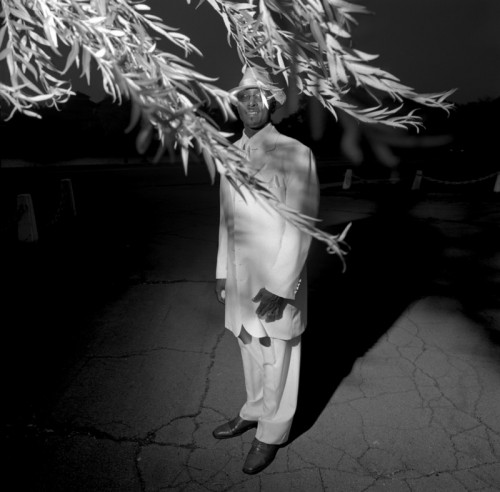
Or this could be seen in a negative way. This man instead of a hopeful figure could be seen as a person with some kind of alternative devious motives. His smile could be seen as sinister in a way. This could then symbolize the corruption in Detroit.
"Child, East Side"

This image portrays a toddler roaming a junk ridden yard in the Detroit suburbs. The blurry quality of the photograph alludes to the obscured perception of a child's eye, unable to fully comprehend the devastation and instability around them. Thus, the child frolics through the trash as if it is her own playground. The trash itself stands as a symbol for the problems, and their consequences, of Detroit. The accumulation of these issues--including racial tension, corrupt government action, unemployment, and crime--creates a troublesome environment for a child to grow up in. The mistakes of previous generations, as well as those that are in power now, build up like trash in the Detroit suburbs. The child in the photograph stands alone, no one there to guide her through the chaos. The younger generations of America are left to clean the mess, burdened with a future of uncertainty.
Abandoned Doll House, Midtown
Subscribe to:
Posts (Atom)