Wednesday, June 25, 2014
The Republic of East L.A.
What I enjoyed and what worked well:
I enjoyed the background information about the author because it also shows where the novel is from. This worked well because the background information about the author changing his life around from being a gang member is inspiring and interesting. This was a big factor of listening more about the novel.
What I learned from this presentation:
I learned about the themes of this novel which were alcoholism and family abandonment, and these themes were described well with explanations. I also learned a lot about the author, which I enjoyed and thought I worked well for the presentation.
Comments/Questions:
The audio of the author reading his pieces was a nice addition to the presentation.

Winter's Bone
What I enjoyed and what worked well:
I enjoyed the long trailer of the film because it gave a preview of the novel. When I see a film and then read a book I have an image of how the characters should look like and what kind of surrounding they are living in. So the film worked well for me in that way so I can understand more about what the novel would be about instead of just speaking about it, and it will give me more imagination to if I ever decide to read the novel.
What I learned from this presentation:
I learned a little about the author, Daniel Woodrell and how he has eight novels. I also learned about a few of the themes of the book which were place and identity, poverty, corruption, drug abuse, and negligence.
Comments/Questions:
I liked the ending with the extra information about the Sheriff and how he was distributing and addicted to meth.
Winter's Bone
The use of the trailer provide a good visual parallel to the story that we were able to visualize the situation and some of the characters and their environment. They all spoke loudly and despite obviously not completely enjoying the book, they knew their stuff and delivered a good presentation.
What I learned:
-Absent father makes main character (Ree) grow up faster than normal
- Law enforcement has no pity/ is corrupt
-Drug trade prevalent in Ozark mountain range
No comments
What I learned:
-Absent father makes main character (Ree) grow up faster than normal
- Law enforcement has no pity/ is corrupt
-Drug trade prevalent in Ozark mountain range
No comments
Friday, June 20, 2014
Buddha In the Attic /The Republic Of East LA/ Winters Bone
The short book Buddha In the Attic was portrayed very nicely in the presentation. The book is about Japanese picture brides who come to America but are surprised to find that they have been deceived. The book focuses on segregation and racism. Important event that occur are the bombing of Pearl Harbor and then World War two is started. The novel is written in a novel like way and this make it beautiful in a way.
The Republic OF East LA presentation was very well done. I especially enjoyed how the group played the recordings of some of the poems that the author has done. It is a book of short stories each one has a major theme. The major themes are abandonment of family, discrimination, struggle for work and money, search for culture and identity.
The Winters Bone presentation was also very interesting. I enjoyed how the group showed the books comparison to the movie. The book is about Ree who goes on a quest to find her father in order to save her property. It was interesting to find out that in real life this place is so corrupt that the sheriff was convicted for distributing drugs. Major themes are poverty, corruption, drug abuse, negligence and the connection between place and identity. overall all presentations were done very well.
Book Presentation Response
The Budah In the Attic
A very interesting presentation. Good job describing picture brides. I learned something new. Connecting the book to racism segregation and hostility worked well.
Winter's Bone
A very powerful and touching presentation. Connecting place and identity to the book worked just wonderful. Good job connecting your book to the Glass Castle.
The Republic of East LA
Nice presentation! Exceptional themes and connections. The presentation was very well prepared organized and smooth. I enjoyed it allot. Learning about the authors cultural background made the presentation much more meaningful and understanding.
Buddha in the Attic
The author of this book is from Palo Alto which I thought was neat. I enjoyed learning about picture brides and the Japanese internment camps during WW2 since I had no previous knowledge of that aspect before the presentation. The different aspects of the picture brides were very striking to me. It surprised me when the group mentioned that the husbands were often ten to twenty years older than the bride. I also thought it was interesting that they related this back to online dating since the meeting was not always what they expected out of each other. I liked this presentation because it was very clear about the time and setting of the book.
Republic of East LA
I thought it was interesting that the author was in a gang for 7 years of his life before becoming a writer. It is very charismatic of him to have started making whiting workshops for children to improve their writing skills. This presentation was developed nicely and had many examples of the poems the author wrote, which gave us a sense of how his personality is. His experience throughout his like has made him a credible author.
Tortilla Curtain
This book by TC Boyle included a lot of symbolism which is interesting because that helps the reader visualize the words they are reading. The coyote represents the illegal immigrants and the natural disaster captures the powerlessness aspect of the novel. This presentation was very well done. I am impressed by the author speaking 24 languages. It is an inspiration for me because I have always wanted to learn more languages. I liked the video because it gave us a sense of the author's humorist personality. I also liked the fact that the book is written from four different points of views because it gives us a realistic sense of what is going on.
Jennifer Government
Jennifer Government sounds like a very interesting book. I enjoy reading futuristic style books because it gives us an idea of what the world might look like in the future which is scary but also a little exciting. I like that the author, Max Berry has some background in networking which makes him experienced in the field of this future capitalistic society he is writing about. I thought that the way corporations go to war with the unions was interesting and outlined the issue of corruption which came up in several of the books we have read this quarter.
The Lone Ranger and Tonto Fist Fight in Heaven
I thought this presentation was well thought out. The youtube clips helped visualize the scenes the group talked about very nicely. This book touches a lot on different cultures such as basketball, the star people, and story telling which is interesting. I liked how they described Adrian as the hero because of how others in the book look up to him as a role model. I also liked that they connected it to a movie called Smoke Signals.
Winter's Bone and Republic of East L.A Review
Winter's Bone
I enjoyed the story line of this book about Ree finding her father to save the house and just the involvement of the police and how they are corrupt. I never heard of this book and it is something I am interested in reading. The group did a good job explaining each character and the trailer seemed pretty interesting too. The real story included at the end may the presentation even more interesting then it already was.
Republic of East L.A
I found this groups author to be the most intriguing because of his gang involvement and now he has many books and is running for governor, he really turned his life around.
The themes seemed interesting with ethnic identity because I think many people have this issue and are still looking for a way to identify themselves.
My question was in any of the stories do any of the characters from other stories cross paths?
Overall good job!
Thursday, June 19, 2014
Buddha / Winter's Bone / East L.A.
The Buddha in the Attic: The background of the novel was explained very well, and I now thoroughly understand the "picture bride" concept and the horrors of Japanese internment. The material seemed well-rehearsed and dense in information, and the excerpt was helpful in understanding the content. The presentation maintained a good balance of slides and speech.
Winter's Bone: The characters and plot were thoroughly covered, and the presentation connected insightfully to Detroit and the American Dream. I enjoyed the choice of handout.
The Republic of East L.A.: The symbolism and the background were clear from the beginning of the presentation. The author biography taught me quite a few things, and I liked the speakers' use of anecdote, personal opinions, and audience interaction. The choice of excerpts and audio samples was interesting, and the analysis was thought-provoking. I would like to know more about basic details of the book -- is it nonfiction or fiction? How is it structured? What is the tone?
Wednesday, June 18, 2014
The Republic of East LA
I learned in this presentation that since it involves Mexican Community in East LA, Every story in the book shows different aspect of the community. And the major themes of the book revolves around struggle for work and money, family values and relationship and search for cultural/ ethnic identity. I also saw this theme in the few parts of the book that my group read so I was able to connect that. The poems in the end is what I really enjoy because I dot really know how to write poems so I have great respect for people who can make them.
Winter's Bone
This presentation was interesting because they mention how the main character's American Dream is to be able to keep her house but the law enforcement is taking that away from her and her family if they don't find her dad. They also shown extra real life example about a corrupt law enforcer officer who got caught back in 2011. I really like how they connected their book to The Glass Castle by saying Ree and Jeannette were similar because they had to grow up in rough situation due to unreliable parents and poverty.
The Buddha in the Attic
This presentation was good and it caught my attention immediately in the beginning since I'm interested learning more about Japanese Culture. The pictures they posted while doing the PowerPoint was really good because it shows how it was connected to real life experience. I learned a lot of things especially with how the "picture brides" received a photo of heir husband however that picture was taken 10 years to 20 years before. So it was surprising to them. It was like online dating. It was also mention that they felt like they were being raped by their husband and making them work. which is complete opposite of what they expected.
The Buddha in the Attic
They did a great job including the history of picture brides and the subsequent Japanese internment. They connected the novel to its history in a way that was engaging and interesting,
What I learned:
- Picture brides were deceived by photos of handsome young men
- After being married, they are exploited
- Mass removal of Japanese Americans after Pearl Harbor bombing -- completely rejected by rest of population
Questions/Comments:
Good job!
What I learned:
- Picture brides were deceived by photos of handsome young men
- After being married, they are exploited
- Mass removal of Japanese Americans after Pearl Harbor bombing -- completely rejected by rest of population
Questions/Comments:
Good job!
Lone Ranger
The Lone Ranger is about a tribe of Native Americans called the Spokane, and also known as the "Star People". Basketball is more than a regular activity for the tribe as it constitutes for a lot of its culture and background.
Jennifer Goverment
Major themes of the book are corporate greed, consumerism, profit over people, freedom by force, corporate warfare and greed. the book is about corporations that kill competitors and customers who buy products from their competitors. The setting is a dystopia. Main characters are Jennifer Government, John Nile, Billy NRA, Violet and Buy Mitsui.
The presentation was well done and clear. I liked how closely related the video was to the book.
The presentation was well done and clear. I liked how closely related the video was to the book.
Jennifers Goverment, The Tortilla Curtain and Lone Ranger Review
Jennifers Government
I learned mostly abu the profit ver people and how this governement obly cares about money and will do anything to make it go in favor of what they want even if it means killing people off and slowly transforming people to consumers.
I found the video at the end of the presentation very interesting, just seeing it in real ;ife situation was shocking.
You can see the hard work the group put into there presentation and they were well informed about their book.
Lone Ranger
In this presentation I enjoyed learning about the different themes seen throughout the book and then how you talked about it then showed a video for each one, that was cool to see a visual. I was surprised about how basketball was so important in that community and considered a gathering.
The recommendation at the end was a good point and I may actually read this book on my own.
The Tortilla Curtain
This was the hardest one for me to understand but it does seem like a powerful book because of the themes throughout- inequality, racism. exploitation and identity. Its interesting how the poverty and affluence are distinctively divided.
The way the group connected it to Detroit and The Glass Castle was great.
Lone Ranger and Tonto Fist Fight In Heaven
The book is about the Spokane tribe (Star people) and how some of it's inhabitants deal with new Indian traditions. There are two major traditions that the tribe has, drinking alcohol and playing basketball. These new ways help the people who consider themselves to be member, socialize. There are two main characters, Thomas and Victor. A major theme is story telling.
Lone Ranger and Tonto / Tortilla Curtain
The Lone Ranger and Tonto Fistfight in Heaven: I liked how the presenters involved their personal opinions and relationships to the story. The symbolic analyses were insightful and engaging, and the presentation made good use of quotes and incorporated excellent choices of videos. It made me want to read this book! There are not many things that make me want to read a book.
The Tortilla Curtain: The use of questions to the class kept the presentation interesting and interactive. The structure was explicit and well-organized; it was clear for me to see what was happening and what was going to happen next. I especially appreciated the comparison to The Glass Castle and Detroit. Overall, this was a thorough job and shows significant effort.
The Lone Ranger and Tonto Fist Fight In Heaven
Daniel and Elba were given the heavy task of setting the bar for the entire class. I enjoyed their presentation style in that they made their presentation feel more like a conversation; almost as if we were sitting in on one of their book club meetings. Their insights on the book were very thought provoking and became more interesting as the presentation went on. Their use of the video was very effective in that they used it to further their excerpts.
Jennifer Government
This group was able to tackle what seemed to be a very complex novel. At times I find myself very confused, but at the same time still compelled to listen to their analysis and how their novel had similarities to the material that we have been exposed to throughout this quarter.
Tuesday, June 17, 2014
Book Club Presentations Day 1
The Lone Ranger and Tonto Fistfight in Heaven
This presentation was full of passion despite the technical errors in the beginning. They were very informed of the novel, giving background information on relevant tribes as well as the setting. They brought up several quotes pertaining to central metaphors that gave us a sense of the overall message of the book.
The Tortilla Curtain
Very intriguing discussion regarding the symbolism throughout the novel. The group gave a very detailed analysis of key characters and the importance of their perspective in the novel. It was also interesting how they tied everything back into the previous two novels we read and the broader themes of the course.
Book Presentation Response
Jennifer Government
I enjoyed this presentation. I liked how the information was distributed among each student and how passionately
they were about the themes in the book. I enjoy how they connected their book to the American Dream as well as current situations that are happening around the world; greed pollution and dog eats dog world. I wonder if American will turn into a Jennifer Government kind of world.
The Tortilla Curtain
I really liked how the group got the audience involved and asked question. This engaged me in and immediately got my attention. I wonder if the information about Mexican is credible in this book due to the fact that is fiction and written by a white male.
Jennifer Government
Explain what you enjoyed and what worked well in each presentation.
The slideshow for their presentation worked well because I was able to follow along easily as to what they were talking about. I really enjoyed watching the video too because it gave similar real life example and convey what the book was trying to tell us/
Explain what you learned from the presentation.
I learned from their presentation that corporate would get anything and can do anything as long as they have the money. That everything has a price including human life.
The Lone Ranger and Tonto Fistfight in Heaven
Explain what you enjoyed and what worked well in each presentation.
I enjoyed watching the video and how they gave context and their opinion during and after each video scene they shown to us. Those video scene they shown to us worked well with their presentation. I like that story involves basketball since I like watching basketball so it caught my attention.
Explain what you learned from the presentation.
Explain what you learned from the presentation.
I learned that the main theme of the book are basketball, storytelling and alcoholism. One main thing that I learned was that although the tribe saw drinking alcohol as a culture because it brought people together but it also caused problems such as domestic violence.
Response to Book Club Presentations
The Lone Ranger and Tonto Fist Fight in Heaven
I thoroughly enjoyed this presentation. The group dealt with technical difficulties with fluidity and efficiency. The conversational tone of Elba and Daniel made it easy for the audience to engage in their material. I also appreciated the fact that they also made real life connections to the book to subjects we may be interested in. The videos also provided another layer of understanding the material. The group did a great job at expressing the crucial role that basketball, alcohol, and fishing plays in the novel.
Jennifer Government
A complete, informative, and delightful presentation. The group was efficient in dividing up the tasks in conveying the material. The PowerPoint presentation was a perfect choice in covering the various components of the project. The videos were exquisitely chosen to fit the overall theme of the book. The chosen excerpts did a good job in disclosing the importance of the theme 'profit over people'.
Monday, June 16, 2014
Notes on Book Club Presentations 06/16/2014
The Lone Ranger and Tonto Fistfight in Heaven by Sherman Alexie
- a story about Native American society in Eastern Washington
- isolated in a reservation
- illusion and dream of regaining back their original culture
- the story's main themes: 1) alcoholism: families crumbled, 2) basketball: a game to determine the best player, the hero, 3) storytelling: not stories from the past but from present, stereotyped Native American culture
Jennifer Government by Max Barry
- a story of extreme capitalism where the government no longer holds control of the society, instead, individual corporations try to win one another
- the story rotates around two main character; Jennifer Government as the protagonist and John Nike as the antagonist. Had past relationship
- main themes: materialism, consumerism, capitalism, funding enemies, profits over people (asking for money to execute the killers of the daughter; excerpt), freedom by force (power)
- corporations use military tactics to attack their opponents; they do not hesitate to kill those who are in their way
- people are on their own
The Tortilla Curtain by T. C. Boyle
- immigrants struggled in achieving the American Dream
- "tortilla," in regards to The Iron Curtain, authentically symbolizes the border between the U.S and Mexico
- cover analysis: 1) cactus: live through difficulties, 2) dark at the bottom, bright at the top: the immigrants live on the bottom of the canyon while the rich white Americans live in luxury, 3) gate around the community: to fence out the colored
- main theme: the idea of American Dream gets twisted because of the situation, exploitation (low wage), powerlessness (uncontrollable natural disaster)
- major difference in the American Dream with The Glass Castle: the A.D can be achieved through hard work and opportunity, but in The Tortilla Curtain, the story is a fiction that tells tragedy, and in the story, working as hard as one could alone is not enough
The Tortilla Curtain
What I enjoyed and what worked well:
I enjoyed the video about the author to see what type of person he seems to be. It's like a first impression of him to see if his writing will be enjoyable to you. The slides were well organizes and had a lot of information to support points. The explanation about the cover worked well, and the questions asked to the audience to interact worked as well.
What I learned from this presentation:
I learned about the title and how it related to The Iron Curtain from Europe but "Tortilla" replaces "Iron" which also plays an important role in the novel. I also learned about the author and how he has awarded pieces of writing. Lastly, I learned about the area on how the rich people living luxuriously separated themselves from the immigrants that were living like homeless people.
Comments/Questions:
Even though time ran out and the excerpts were read, I like the presentation because the group provided a lot of information and explanations.
Jennifer Government
What I enjoyed and what worked well:
I enjoyed the explanations with each quote on how it relates to a theme in the novel. The video that was presented helped broaden the point of how the corporations used their money and power in the novel. The video and the excerpts from the novel worked well in the presentation, giving a feel of what will be read.
What I learned from this presentation:
I learned a lot about how the corporations had a lot of control over the government and people because they had so much money. I learned about John Nike and Jennifer Government and what roles they played in the novel.
Comments/ Questions:
The presentation gave me a futuristic vibe because of how corporations were taking control and how Violet was a hacker. I liked how the excerpts were read with enthusiasm and were interesting, kept me focused to hear more.
The Lone Ranger and Tonto Fistfight in Heaven
What I enjoyed and what worked well:
I enjoying the subject of basketball because I love basketball, so this presentation caught my attention very quickly. I enjoyed watching parts of the movie with the videos because it helped the overall explanation of what was being said, which also worked well. Lastly, the attitude towards the book was enjoyable to hear about because it sounded like an amusing book to read in the future.
What I learned from this presentation:
I learned quite a few things, like the overall subjects in the book like basketball, storytelling, and alcoholism. From the introduction I learned about the author and a little about the Spokane Indians. I learned about how alcoholism was a big problem to the people and was something a lot of people in the tribe did.
Comments/Questions:
Really enjoyed hearing about the novel and watching parts of Smoke Signals.
The Tortilla Curtain
The connections between the other books we have read and their book were insightful and the presentation overall was very balanced and exciting.
What I learned:
-Connection between Tortilla Curtain/Iron Curtain, the tortilla is flimsy and therefore ineffective as a wall as opposed to iron.
-Hard work might not be enough to overcome the obstacles that stand in the way of the American Dream, such systemic racism that seems to pervade throughout society.
Questions:
Why is it that people fall into racism despite not necessarily being racist?
Jennifer Government
They really knew the book well and their analysis was in depth and relevant. They were able to incorporate their analysis of quotes in order to further the ideas they had about the book.
What I learned:
-Author worked for HP, his perspectives surrounding capitalist society is more accurate and realistic
-Certain characters represent certain aspects of society
-Corporate takeover of the world means that everything has a price, including human life.
Questions:
How did the different companies determine which side they were going to be a part of?
The Lone Ranger and Tonto Fistfight in Heaven
The video clips worked well in adding another layer of understanding to the material that they were presenting.
What I learned:
They play basketball and drink a lot at tribal gatherings.
Alcoholism, basketball, and storytelling brings the reservation together.
They have a love/hate relationship with alcohol that is a part of the culture but also is at the root of many problems in the society such as domestic violence.
Basketball has become almost a cultural tradition as the bouncing of the ball can be compared to the beating of a drum.
Questions/Comments:
I think that literature that discusses the Native Americans search for identity in the present day is interesting and relevant and should be more widely read.
Responses to Group Presentations: Monday's class
Please respond to each of the group presentations from Monday here. Include the title of the group's book in your heading so it is clear which group you are responding to.
Groups presented on:
The Lone Ranger and Tonto Fistfight in Heaven
Jennifer Government
The Tortilla Curtain
Explain what you enjoyed and what worked well in each presentation.
Explain what you learned from the presentation.
Include any questions or comments that the presentation raised for you.
Groups presented on:
The Lone Ranger and Tonto Fistfight in Heaven
Jennifer Government
The Tortilla Curtain
Explain what you enjoyed and what worked well in each presentation.
Explain what you learned from the presentation.
Include any questions or comments that the presentation raised for you.
Sunday, June 8, 2014
Friday, June 6, 2014
Jennifer Government source #1
http://library.foothill.edu/uhtbin/cgisirsi/?ps=SLHfa80YAK/SIRSI/97600016/9
The source is a book called Reign of Error, about the destruction of public education as privatization has risen in the US
The source is a book called Reign of Error, about the destruction of public education as privatization has risen in the US
The Tortilla Curtain By T.C. Boyle
http://go.galegroup.com/ps/i.do?id=GALE%7CA18839349&v=2.1&u=foothill_main&it=r&p=LitRC&sw=w&asid=c6919a98a682bd73f82788d68aa97c44
Author: James, Knudsen
Author: James, Knudsen
Jennifer Government
"Subterranean Capitalist Blues"
http://search.ebscohost.com/login.aspx?direct=true&db=ulh&AN=91657798&site=src-live
http://search.ebscohost.com/login.aspx?direct=true&db=ulh&AN=91657798&site=src-live
Winter's Bone- Interview with Daniel Woodrell
http://go.galegroup.com/ps/retrieve.do?sgHitCountType=None&sort=RELEVANCE&inPS=true&prodId=LitRC&userGroupName=foothill_main&tabID=T002&searchId=R1&resultListType=RESULT_LIST&contentSegment=&searchType=AdvancedSearchForm¤tPosition=1&contentSet=GALE%7CA249224672&&docId=GALE|A249224672&docType=GALE&role=LitRC
Buddha in the attic
- Authors:
- Ward Crawford, Miki
Suenaga, Shizuko
Kaori Hayashi, Katie - Publication Information:
- Santa Barbara, Calif : Praeger. 2010
- Description:
- eBook.
- Subjects:
- Women--Japan--Biography
Intercountry marriage--United States--Case studies
World War, 1939-1945--Social aspects--Japan
World War, 1939-1945--Social aspects--United States
War brides--United States--Interviews
Japanese American women--Interviews
Oral history--United States
Women immigrants--United States--Interviews - Categories:
- HISTORY / Military / World War II
BIOGRAPHY & AUTOBIOGRAPHY / Historical - Related ISBNs:
- 9780313362019. 9780313362026.
- Accession Number:
- 319101
Daniel Woodrell, Winters Bone
Daniel Woodrell, Winters Bone
http://eds.b.ebscohost.com/ehost/detail?vid=11&sid=5df65f72-2102-4f79-a5c2-d3d00d154ed8%40sessionmgr110&hid=101&bdata=JnNpdGU9ZWhvc3QtbGl2ZQ%3d%3d#db=n5h&AN=Q4K146780274611
http://eds.b.ebscohost.com/ehost/detail?vid=11&sid=5df65f72-2102-4f79-a5c2-d3d00d154ed8%40sessionmgr110&hid=101&bdata=JnNpdGU9ZWhvc3QtbGl2ZQ%3d%3d#db=n5h&AN=Q4K146780274611
Winter's Bone
"Riddles across the sky": Daniel Woodrell talks about Winter's Bone
http://go.galegroup.com/ps/retrieve.do?sgHitCountType=None&sort=RELEVANCE&inPS=true&prodId=LitRC&userGroupName=foothill_main&tabID=T002&searchId=R1&resultListType=RESULT_LIST&contentSegment=&searchType=AdvancedSearchForm¤tPosition=1&contentSet=GALE%7CA249224672&&docId=GALE|A249224672&docType=GALE&role=LitRC
http://go.galegroup.com/ps/retrieve.do?sgHitCountType=None&sort=RELEVANCE&inPS=true&prodId=LitRC&userGroupName=foothill_main&tabID=T002&searchId=R1&resultListType=RESULT_LIST&contentSegment=&searchType=AdvancedSearchForm¤tPosition=1&contentSet=GALE%7CA249224672&&docId=GALE|A249224672&docType=GALE&role=LitRC
The Lone Ranger and Tonot Fistfight in Heaven
Link: http://go.galegroup.com/ps/retrieve.do?sgHitCountType=None&sort=RELEVANCE&inPS=true&prodId=LitRC&userGroupName=foothill_main&tabID=T001&searchId=R1&resultListType=RESULT_LIST&contentSegment=&searchType=BasicSearchForm¤tPosition=1&contentSet=GALE|A100608727&&docId=GALE|A100608727&docType=GALE&role=LitRC
Title: The approximate size of his favorite humor: Sherman Alexie's comic connections and disconnections in The Lone Ranger and Tonto Fistfight in Heaven
Author: Joseph L. Coulombe
Book Club Novel: The Buddha in the Attic by Julie Otsuka
- The Triumph and Tragedies of Japanese Women in America: A View Across Four Generations.
- Link: http://eds.b.ebscohost.com/ehost/pdfviewer/pdfviewer?sid=8547b0cf-5081-4064-b2e2-9d5c5644a549%40sessionmgr113&vid=7&hid=107
- Authors: Sakamoto, Taylor1
- Source:
- History Teacher. Nov2007, Vol. 41 Issue 1, p97-122. 26p.
- Document Type:
- Article
- Subject Terms: *JAPANESE American women
*WOMEN -- United States
*RACE discrimination
*EMIGRATION & immigration
*DISCRIMINATION - Geographic Terms:
- UNITED States
- Abstract:
- The article relates the story of four-generations of Japanese-American women and how their attitude, Shigate ga nai which can be translated as "that which cannot be helped," allowed them to persevere through racial discrimination and immigration. It details how the increased demand for Japanese laborers resulted to anti-Japanese sentiment in the U.S. which in turn led to the passage of laws in the U.S. that restricted immigration. It describes the entry of the first generation of Japanese women in the U.S. as picture brides. Some of the laws that negatively impact the future of Japanese-Americans include the Alien Land law of 1913 in California.
- Author Affiliations:
- 1Alta Sierra Intermediate School Clovis, California
- ISSN:
- 0018-2745
- Accession Number:
- 28340114
The Republic of East LA, Luis J. Rodriguez
The Republic of East LA:
The Multicultural Marketing of Urban Fiction: Temporality, Language, Genre, and Readership(s) in Luis J. Rodriguez's The Republic of East L.A. and Music of the Mill
Author: Jens Martin Gurr
http://go.galegroup.com/ps/retrieve.do?sgHitCountType=None&sort=RELEVANCE&inPS=true&prodId=LitRC&userGroupName=foothill_main&tabID=T001&searchId=R3&resultListType=RESULT_LIST&contentSegment=&searchType=BasicSearchForm¤tPosition=1&contentSet=GALE|H1420107487&&docId=GALE|H1420107487&docType=GALE&role=LitRC
David Koo Library Research Resource
The Tortilla Curtain by T.C. Boyle
http://go.galegroup.com/ps/retrieve.do?sgHitCountType=None&sort=RELEVANCE&inPS=true&prodId=LitRC&userGroupName=foothill_main&tabID=T001&searchId=R4&resultListType=RESULT_LIST&contentSegment=&searchType=BasicSearchForm¤tPosition=1&contentSet=GALE|H1100098667&&docId=GALE|H1100098667&docType=GALE&role=LitRC
- Heather J. Hicks
http://go.galegroup.com/ps/retrieve.do?sgHitCountType=None&sort=RELEVANCE&inPS=true&prodId=LitRC&userGroupName=foothill_main&tabID=T001&searchId=R4&resultListType=RESULT_LIST&contentSegment=&searchType=BasicSearchForm¤tPosition=3&contentSet=GALE|A188642397&&docId=GALE|A188642397&docType=GALE&role=LitRC
- Oscar J. Martinez
Monday, May 19, 2014
Fallacies in Detroit
In Charlie LeDuff's book Detroit an American Autopsy, there are a number of fallacies used from The Thinker's Guide to Fallacies: The Art of Mental Trickery and Manipulation. Some of the Fallacies used are:
#5 Appeal to Fear
This fallacies is used in many parts of the book. It is shows on how corrupt the government is in Detroit. The government has many people controlling the face figure of who the citizens see to go through with their own ideas. These figures are being controlled through fear of what could happen to them if they don't listen.
#14 Devise Analogies
This fallacies is used metaphors and analogies to get your point out to the audience and could be false. In the book, LeDuff uses this fallacies to show how bad a situation is in the book. How little things could mean a lot in Detroit, and how the situation is very shocking.
#19 Demonize His Side, Sanitize Yours
This fallacies is basically putting your view as good and other's view as bad. This is used in LeDuff's writing because all LeDuff is writing about is the bad Detroit and he doesn't include the parts of Detroit that are decent to see. He only talks about the parts in Detroit that are run down and need help from the government. But there are nicer areas in Detroit isn't what LeDuff describes in his book.
Fallacies found in Detroit: An American Autopsy
Reading the Fallacies book helped me connect many of the mental manipulations to the book Detroit: An American Autopsy, since a lot of the book focuses on the corrupt politics of Detroit as a city. However, the fallacy that stood out to me as I was reading Detroit, was "Dirty Trick #7: Appealing to popular passions". This trick was unique, because it was not the author, Charlie LeDuff using a fallacy to manipulate the reader, but the new mayor using it to appeal to the voter. "After retiring from basketball, he started his own business manufacturing auto parts in Detroit. He ran his mayoral campaign tutoring this executive acumen" (p.176).
Although his statement appealed to the voters of Detroit, LeDuff adds: "An elegant, introverted and geriatric figure, Bing neglected to tell the voters that his business was failing and that it had existed hand-to-mouth for a number of years" (p.176). This shows that Bing was appealing to the voters of Detroit by identifying with being apart of the auto industry and starting his own company (to show success) but denied telling the voter the whole truth.
Although his statement appealed to the voters of Detroit, LeDuff adds: "An elegant, introverted and geriatric figure, Bing neglected to tell the voters that his business was failing and that it had existed hand-to-mouth for a number of years" (p.176). This shows that Bing was appealing to the voters of Detroit by identifying with being apart of the auto industry and starting his own company (to show success) but denied telling the voter the whole truth.
Fallacies in Detroit
Appeal to Pity is used by Mario Willis when trying to escape prison time for hiring an arsonist who ended up killing Walt Harris: "I just once again, just thank you. I ask you to have mercy upon me and I'm very humbled by the situation."
LeDuff's coverage of Monica Conyers is a subtle and ongoing invocation of Make Your Opponent Look Ridiculous. Conyers is consistently portrayed as a caricature of a spoiled, vain, hot-tempered weasel.
LeDuff also employs Demonize Their Side, Sanitize Yours throughout the book. He portrays himself as a bold, fearless hero crusading to expose Detroit's evils, while his opponents are crooks and cheaters who are destroying the city.
Fallacies in Charlie LeDuff's Detroit: American Autopsy
Charlie LeDuff in Detroit: American Autopsy combines a "gritty reportage and personal memories" (Goodreads) which accurately describes the situation in Detroit, although, as readers, there are some of the occurrences that he writes in the book we would never know were proven. If the journal was a reportage that is supposed to report only truth, yet, some of the metaphors that he uses to express his view seem a little bit to "extreme" to readers. According to Fallacies, this move fits Dirty Trick #14 about devise analogies. In Detroit, after the corrupt mayor had been taken out, LeDuff promised himself to find out who was responsible for the outrage of murderers walking free while the city burned night after night. "I was going to become real reporter. Someone had to answer this shit. ... That's when a bird shit on my face." (158) We never know if this was truly what happened to him as he voices the irony in the tragedy. Another example was when GM planned to officially declare bankruptcy, and the whole city lost its dependable workplace. "This was like living in Pompeii, except the people weren't covered in ash. We were alive. ... And if you needed a metaphor for how retrograde things were becoming, a beaver was sighted nesting in the Detroit River for the first time in seventy-five years." (175) When Detroit became the home of automobile industries, the rapid development of city was said to have caused beavers to "extinct," and LeDuff claims that the downfall of Detroit many years later have caused the beavers to come to sight, yet again. This might be a little to far, however, we never know if this was part of the truth that he told in his journal.
In addition to the point, Detroit in general describes how bad it was in Detroit and how damaged the city and the people were. In this case, LeDuff seems to demonize others' side and sanitizes his presence when he went back to his hometown. The government was falling, the firehouses were broke, the people were all bad, and murders followed him everywhere he goes. And there he was, reporting and publishing his stories to get the people in charge to do the right thing. Even tough this is not the focus of the book, he fails to recognize the good parts about Detroit, which is categorized to Dirty Trick #19 according to Fallacies. He describes himself as the only one source of virtue among all evil things in Detroit, and explains his moves to be righteous.
In addition to the point, Detroit in general describes how bad it was in Detroit and how damaged the city and the people were. In this case, LeDuff seems to demonize others' side and sanitizes his presence when he went back to his hometown. The government was falling, the firehouses were broke, the people were all bad, and murders followed him everywhere he goes. And there he was, reporting and publishing his stories to get the people in charge to do the right thing. Even tough this is not the focus of the book, he fails to recognize the good parts about Detroit, which is categorized to Dirty Trick #19 according to Fallacies. He describes himself as the only one source of virtue among all evil things in Detroit, and explains his moves to be righteous.
Fallacies in Detroit: An American Autopsy
LeDuff's style of writing uses many different fallacies. He uses these fallacies to appeal to emotions in the reader causing a more profound reaction in the direction pointed to by the induced feelings. Of these many fallacies he uses #14 Devise Analogies, also known as metaphors to provide a deeper reaction in his audience. He plants metaphors in ways that describe a situation in more understanding terms as well as to perhaps tell more about the situation. The are many #5s which are Appeals to Fear. They are constantly being used by those in charge to keep those with less power too afraid to move. For example with politicians and the general public. In the US, depending on which party you associate with, they are always telling you things that you should be afraid of. The politicians appeal to the fears of the public to get their support. LeDuff also employs #15 that being Questioning Your Opponents Conclusions. He has to make himself look better than all the "enemies" he has in this book. He constantly questions their conclusions in order to illustrate just how much of what they say is proven to be true and not just wild speculation.
Fallacies in The Glass Castle
In The Glass Castle, I found the fallacies 2, 6, 18, and 23 to show up throughout the story.
Fallacy number 2, "Accuse him of sliding down a slippery slope", refers to Rex and his alcoholism when people try to confront him about him and what it will do to him in the end. Fallacy number 6 has to do with appealing to pity. This one made me think of Jeannette's mother when she gets caught stealing food for herself. She says she needs it more than the kids do and makes up excuses so that the family feels pity for her. It shows how manipulating she is and how she makes people feel bad for her. Fallacy 18, Deny or Defend Inconsistencies, also has to do with the mother. Throughout the book, she does many questionable things and denies she did anything wrong. She says she cares about her kids even though her actions prove otherwise. The 23rd fallacy is to ignore the evidence. I relate this to when Rex responds to the abuse going on in his mother's house. He chooses to ignore the problem so that he does not have to deal with it.
Sunday, May 18, 2014
Fallacies In The Book Detroit: An American Autopsy
In the book Detroit: An American Autopsy I notice that some fallacies are used.
There are three major Fallacies: 6, 14, 41
Fallacy number 6
Appeal To Pity (or sympathy)
Charlie LeDuff may be using this when explaining his personal connections to the city of Detroit. When LeDuff informed me as a reader that his sister had died, it made me feel a emotional connection or sympathy for him. This caused me to become more understanding about his points of view.
Fallacy number 14
Devise Analogies (and metaphors) That Support Your View
LeDuff uses many metaphors and analogies in his book. He seem to use them specifically when he feels strongly about a topic. He does this in order to get his point across in a more convincing way. He also uses these when he wants to emphasize how ridiculous something is.
Fallacy number 41
Treat Abstract Words and Symbols As If They Were Real Things
LeDuff does incorporate many abstract symbols in his story. These symbols can be interpreted in many ways. these symbols are used to further prove his point but can do the opposite if someone views these symbols in a different way.
Friday, May 16, 2014
Fallacies in either The Glass Castle or Detroit
Instructions:
Before Monday's class, briefly describe 3-5 specific logical fallacies that you have identified in either The Glass Castle or Detroit, to begin preparing for the Midterm Exam.
Tuesday, May 13, 2014
Four Alarms, East side
I picked this picture of a street that is hidden by a smoke screen. You can see a fire fighter hose on the ground as if its a sign that their are firemen inside the smoke screen attempting to take out the fire. I think this is a powerful photo in many ways relating to this book. It's a mystery whats going on behind the smoke. A typical day in Detroit on the East Side is full of fire and you'll never know if that is going to be the morning you ever wake up because tragedies strike at any moment in this area. It also shows how big of a fire there is and that it is most likely to big of a task for the firefighters. A fire this big would need ten hoses to put it out. Not just two, one of which looks like a neighbors yard hose. Fires have haunted this city by ruining so many beautiful homes. They never get repaired then turn into dumps or wasted spaces of land. It is unbelievable that the government hasn't done more to correct this.
Friday, May 9, 2014
Packard Plant: East Side
This image reflects upon the overall desolate condition of some parts of Detroit. The abandoned building which appears to be a factory has been multipurposed, as even a broken-down boat is in the middle of such a place. This goes to show the pure absurdity of the situation and how also the woman seems to spend her days trying eke her existence earning money through non-conventional means. However this strikes as strange as this may have been staged to simply demonstrate an example of the strange and degraded living conditions.
Child, East Side
This picture shows a little girl walking through a garden of an old destroyed house only wearing a diaper. The houses in the back are abandoned and wear down. On the grown were the girl is walking around its filled with garbage all over the ground. You can barely see the ground from all the things that have been dumped. This picture makes me feel so sad, and I think proven the conditions of Detroit. You can see the houses from the "American Dream" in the background been destroyed and become a dump site. I also think its touching because of the little girl walking with now clothes in these conditions, because the message I think the picture is communicating that this is the children's future in Detroit if we don't make a change.
Abandoned Dollhouse, Midtown

The picture shows a
dollhouse in an abandoned lot. We can also see in the background some abandon
houses. I think this picture tells us what the American Dream has become in Detroit.
Before it was one of the biggest and flourishing city in the United States now
it has become one of the poorest city. Before American Dream was define using
the 5 milestone and one of them is having a (white picket fence) house. I think
the abandoned dollhouse represents the white picket fence house that Americans
dream of having before but now it seems to have become impossible to be able to
have your own house in Detroit. Because of the situation they have in Detroit, which
it showing how the American Dream has become impossible to achieve in Detroit.
Response #5
Unclaimed Dead, County Morgue, Midtown
Dozens of unclaimed bodies are piled up in the county morgue. This photo symbolizes the ruinous conditions of Detroit society. Nameless corpses are abandoned side-to-side, with no families or friends to claim them. This depiction of the county morgue portrays the tomb that Detroit has become. This is in parallel with Charlie LeDuff's representation of the city because the memoir's purpose was to perform an autopsy of Detroit. These corpses are covered up from head-to-toe, making it impossible to get any idea of what has happened to them. Similar to the man frozen under the elevator shaft, the cause of death is opaque. The makeup of Detroit's downfall is unclear and smothered by internal and external factors, similar to the dead bodies unclaimed in the county morgue. Both the city of Detroit and the people in this picture are in need of an investigation. How did this happen? Why did this happen?
Dozens of unclaimed bodies are piled up in the county morgue. This photo symbolizes the ruinous conditions of Detroit society. Nameless corpses are abandoned side-to-side, with no families or friends to claim them. This depiction of the county morgue portrays the tomb that Detroit has become. This is in parallel with Charlie LeDuff's representation of the city because the memoir's purpose was to perform an autopsy of Detroit. These corpses are covered up from head-to-toe, making it impossible to get any idea of what has happened to them. Similar to the man frozen under the elevator shaft, the cause of death is opaque. The makeup of Detroit's downfall is unclear and smothered by internal and external factors, similar to the dead bodies unclaimed in the county morgue. Both the city of Detroit and the people in this picture are in need of an investigation. How did this happen? Why did this happen?
Abandoned Dollhouse
The picture depicts a dollhouse among some rubble in an abandoned lot. In the background, you can see several abandoned houses. The dollhouse is supposed to look like some kind of fancier, higher-end house. The irony of it is that its marked, defaced, and is surrounded with rubble and trash, much like a lot of the houses in Detroit. This can be thought of as a symbol for Detroit itself. It was once a thriving city that was the standard of living for a time. Over the years though it's gotten extremely rundown and the once thriving businesses and the cookie-cutter working middle class is no more. The bottle of alcohol in the balcony of the toy house can be seen as a symbol of how many of the residents of Detroit have fallen to drugs and alcohol.

Packard Plane, East Side
I chose to analyze this picture because it stood out to me the most in the way that everything just seemed so out of place. Besides the obvious out of place objects, i.e the abandoned boat that for some strange reason is in the middle of the warehouse. The other main subject in this photo is the woman clearly as an escort, which you can ultimately assume that she conducts her business inside the abandoned buildings. Unfortunately, in cities like Detroit, people have to resort to selling their bodies, instead of getting a job. I would be very interested to see this exact picture in this exact location but only 30 years before.
Abandoned Dollhouse
A white, two-story dollhouse stands in a scattered pile of rubble. Although the dollhouse is an emulation of a luxurious, upper-class residence, its decaying condition and depressing surroundings clash with its tone. Detroit used to be a place of opportunity, a manufacturing capital -- see the tiny Fisher-Price plaque in the upper right of the toy -- until it was overrun with corruption and poverty. A disproportionate glass bottle, once containing Smirnoff vodka, is littered on its balcony, mirroring how Detroit's residents have turned to drugs and alcohol. In the background, some trees obscure out-of-focus houses. There is not much we can discern, but we can guess that the blurry houses are in a decrepit state and are empty, or inhabited by drug addicts.
Thursday, May 8, 2014
Front Steps, Southwest Side
Front Steps, Southwest Side
The image shows an old worn down home in Detroit, with windows covered by sheets of plastic instead of glass, and panels from the door frame missing. A young white woman sits on the front steps next to a man who looks to be slightly older, possibly her brother. As she takes a drag of her cigarette you can see that the man next to her is missing his right arm, he looks down towards the ground, away from the smoke. Just above him is a faded American flag, this image in a way represents the current state of Detroit. A city which was once carried ideas of pride and accomplishment has now been worn down. The flag is faded so much it's image is hardly visible, just as Detroit is now the shell of its former self. The family pictured, and the house they appear to live in have both seen better days. Just as Detroit has seen one too many overwhelming obstacles, this family too, has been crippled.Packard Plant, East Side
This photo stands out to me because it shows how abandoned Detroit is and how the city looks almost post apocalyptic. The woman in the picture also caught my eye because it reminds me of Charlie LeDuff's sister who died in a car accident one night while prostituting herself out to men on the street. It really puts things into perspective and makes me realize what respectable women like LeDuff's sister would have to resort to because of what has happened to the city. The woman in the picture looks like she might be heading towards the broken down apartment buildings for shelter. I like that Reina Carissa's post uses the term "ghostly town". I think that is an accurate way to describe the picture and what it represents. What seems to be an abandoned boat in the middle of the decaying buildings give off the feeling that the place is not safe and people should be very careful where they go in Detroit. The woman in the picture is the most shocking part of the photo because her awkward position and lack of attire suggests that her situation is so bad that it is irreversible and she, along with plenty of other young women like her, are doomed if they stay in this town. 

Funeral of an Innocent Boy, East Side
The photo of the funeral for innocent boy was startling to me. The fact that the close family and some friends seem to be surrounding the boy and then others are sitting down, looking like they are waiting for a train. The looks on these people's faces were shocking. They just seemed so habituated in a way that did not seem normal or appropriate for the death of a human being. This photo speaks to the massive amounts of violence that is running rampant in the streets of Detroit and is taking no prisoners. This photo exemplifies that no one is safe from it and that something must be done to avoid these in home funerals and the deaths of innocent people across Detroit.
The Ruins of Detroit

Detroit: American Autopsy by Charlie LeDuff
Photograph by Danny Wilcox Frazier
The image of "ghostly town" that LeDuff uses to describe his native city, Detroit, in his journal suits the picture above, that is also shown on the back page of the book. The abandoned building, surrounded by debris and garbage, a wrecked boat, and the back of a woman - almost naked - showed how awful it was in Detroit, that nobody gives a "damn" about anything that happened in town. The woman in the picture also reminded me of Charlie's sister that he describes in the book. People looking at the picture above might be disgusted, ashamed, of how the woman seemed to have gone too far, but she could be a victim of some crime and she could also be someone as close as a family. It terrifies me imagining what is she up to, wearing only her underwear, stocking, and heels, in that particular surrounding.
Firemen, Eastside
I chose this image because it spoke to me the most. Here are three firemen which appear to be examining the remains of a burned out building. The firemen are dirty and covered in soot, they also look dead tired the one in the middle standing is using his hook as a rest as one of the other one takes a knee. When you first look at this picture one thing that did not pop out at me was the fact that the fireman on the far left is making a face. He appears to be frowning, but it looks almost exaggerated like he is fighting back tears. I think that he is fighting back tears here, which makes this a picture of three firemen in quiet desperation watching their city burning around them.
This really is a reflection of Detroit, with the city bankrupt they are literally at rock bottom with nowhere to go but up. Even though they are at the bottom they are still there and with the city collapsing these men have the hopeless task of saving it.
"SUMMER NIGHT, BELLE ISLE"
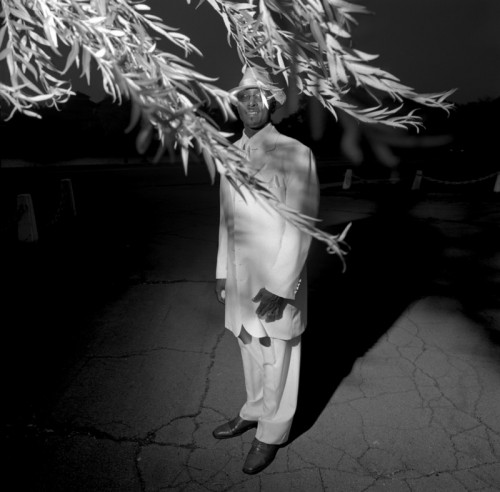
Or this could be seen in a negative way. This man instead of a hopeful figure could be seen as a person with some kind of alternative devious motives. His smile could be seen as sinister in a way. This could then symbolize the corruption in Detroit.
"Child, East Side"

This image portrays a toddler roaming a junk ridden yard in the Detroit suburbs. The blurry quality of the photograph alludes to the obscured perception of a child's eye, unable to fully comprehend the devastation and instability around them. Thus, the child frolics through the trash as if it is her own playground. The trash itself stands as a symbol for the problems, and their consequences, of Detroit. The accumulation of these issues--including racial tension, corrupt government action, unemployment, and crime--creates a troublesome environment for a child to grow up in. The mistakes of previous generations, as well as those that are in power now, build up like trash in the Detroit suburbs. The child in the photograph stands alone, no one there to guide her through the chaos. The younger generations of America are left to clean the mess, burdened with a future of uncertainty.
Abandoned Doll House, Midtown
Wednesday, April 30, 2014
Blog post: Mr. Sam and Jazzy
In these two articles, Sam Walton and Shawn Corey Carter, better know as Jay-Z, are both examples of a "rags to riches" story, with a twist. Both of them had fallen to the "easy road" to success, notably Jay-Z has spent a large chunk of his young life hustling and dealing illegal drugs. Walton took advantage of small towns and basically ran out the local businesses and threatening to alter their way of life, and when his company exploded, necessities such as employee wages were neglected. Jay-Z took a much more underground approach with his drug dealing, undercutting other dealers by setting a lower price and getting his "product" cheaper than anyone else. It became a symbol of capitalism, with "America had become more like Wal-Mart. It had gotten cheap. Prices were lower, and wages were lower. There were fewer union factory job, and more part-time jobs as store greeters."
Jay-Z developed a similar method, by creating his own line of personalized products such as clothing, sneakers, vodka, cologne, and his records. His response to those who called him a "sellout or materialist", he replied that selfishness was the appropriate response to the events he faced.
Sam Walton and Jay-Z
Sam Walton made business with his philosophy of selling more for cheap, which got him a lot of buyers and a lot of success. Walton was more to save money which is where he bought in bulk and sold the items to make profit. He never splurged with his money even though he was at one point the richest man in America. Walton would do anything so he could save money on items. His savings on buying items to sell in stores would turn into more profit.
Jay-Z was a man who wanted the money and would do anything to get it. He would keep working and working to get the money. Especially with his label and music, he worked hard so he can get the money. His way of getting money was a chase. Jay-Z would do anything, even if it meant to put it life on the line. When he had the money, he would help his mom because his dad had left them. But because he loved money and had a lot of it, he would also spend it on unnecessary things like jewelry and on women.
The similarities that these two articles have is the way both Sam Walton and Jay-Z started poor and became rich. They both want to make money, but for different purposes. They both are also talked about badly for what they do for their business. Walton would sell items that Walmart claims is made in the states but is actually from overseas. Workers and buyers would dislike these type of actions Walton would do for his business. Jay-Z would be talked about his disloyalty to his partners and the music that put out that parents wanted their children to stay away from.
The differences would be Sam Walton was cheap. He would get cheap haircuts and even pick up a nickel on the ground even though he had so much money from his business. With Jay-Z, he loved to get money but also used liked to spend it. He didn't care about cutting people out of his business or paying his workers less than they should be earning. Jay-Z did this for his profit to become richer, not because he thought he doings help them.
Response article #4
In both of Parker's articles, he documents the two business giants of Jay-Z and Sam Walton. They both have succeeded in the "American Dream". Although they came from "humble" beginnings, they both sacrificed happiness and morals for success. Jay-Z would sell drugs and later in the future would sell music. Then Sam Walton who would sell clothes and merchandise. Walton only at first wanted to provide for his family and get them a good education, however jay-Z wanted to achieve is lifelong goals and not let anyone interfere. We see both of their tactics and mind-set to achieve this dream resemble almost a ruthless greed. With evidence of Sam Walton's empire affecting employees and local businesses. Then Jay-Z's song content to connect better with listeners to revive more popularity. I begin to wonder, if we're following false icons to success.
Response #4
George Packer's articles of "Mr. Sam: Sam Walton" and "Just Business: Jay-Z" provides strikingly similar stereotypical stories of 'rags to riches'. Both Jay-Z and Sam Walton had unparalleled motivation to money, perhaps it is not an exaggeration to say it was an obsession. They both valued monetary success higher than anything, at the cost of morals and sometimes happiness. George Packer rightfully portrays the lives of both icons in a negative manner; Jay-Z as a paranoid mobster contributing to pretentious and violent values, while Sam Walton created a culture of cheapness and low quality.
Jay-Z and George Packer's difference is in that Jay-Z was making money to survive, whereas Packer was a miserly man from the start. The background of the two is drastically different; George Packer was a man with education from mainstream society (high school, college, retail) and Jay-Z was a man who started from selling drugs and rapping. Both carry themselves dramatically differently as well, Jay-Z chooses extravagance and flamboyance while Packer displays stinginess and obscurity. In contrast to the similarity in that they both value money over everything they hold different philosophies on what money represents and have been brought up from different backgrounds.
It is my opinion that these two figures are the type of people that are destroying society. The two people are so glorified in society that people view the values of pretentiousness, stinginess, and condescension as something that's good. These values are a part of what is destroying America, and these values are making monsters from the lowest of social classes to the highest. Money holds way too much value in today's life, and there needs to be a fundamental change in that philosophy.
George
Parker’s articles, Mr. Sam, Sam Walton, and Just Business, Jay-Z shares the
story of how these two mega-businessmen went from rags to riches and their own
version of the American dream. In both articles we see the both situations,
Walton’s story of growing up a white entrepreneur who would go on to create one
of the biggest franchises ever. Whereas Jay-Z’s story is less subtle, doing
anything that he could to make a dollar, even if it meant putting his life on
the line. In both articles, I noticed that both men had started their journeys
only as humble Americans just like the rest of us, but with enough hard work,
dedication, and some luck on the way, success for these two embodied what it
means to achieve the American dream. Although their come ups were quite
different, their persistent efforts to put out their product to the American
people truly are inspirational stories; giving me hope that maybe one day, I’ll
get to marry a Beyonce too.
Parker's Articles Response
In Packer’s articles,
both men, Sam Walton and Jay Z, are similar to each other by working their way
up from low class to upper class (upward mobility) which is one of definition
of American Dream. Sam Walton saw American dream in a different way. It’s not
about becoming super rich because he said “money never has meant that much to
me.” He define rich, which I believe his American dream, as “ If we
had enough groceries, and a nice place to live, plenty room to keep and feed my
bird dogs, a place to hunt, a place to play tennis and the means to get the
kids good education.” This means that he just wanted enough money to provide
his family and give his children a proper education. On the other hand, Jay Z grep
up from “a Marcy kid no one ever noticed before in the middle of a crowd,
rhyming , throwing out couplets…” to a very successful rapper today. He taught
as that in order to achieve the American Dream, “don’t let them diminish your
accomplishment and dim your shine.” Meaning that don’t let anyone interfere
your achievements to gain the American dream and not let other stop you from
getting it.
Jay-Z and Sam Walton
George Packer's articles documenting the rise of two megabusinessmen, Sam Walton of Wal-Mart fame and rap legend Jay-Z, bring to light some interesting and rather dark perspectives on what success is and what it means to us. We see in both of them a passion for thrift and merciless efficiency, and in Jay-Z a willingness to sacrifice righteousness for money, power, and success. Walton's immorality is more subtle, but it his visible in how he treats local businesses, not to mention the lack of philanthropy. As repulsive as their tactics can be, we can't help but be inspired by how these two men quickly rose from low-income lives to explosive luxury. It leads us to wonder: is the American Dream really just...greed?
Subscribe to:
Posts (Atom)